Pages

Tuesday, June 12, 2012


More Reason to Visit Jersey!

Using the High Line as a Model, Jersey City Bets on the Embankment

Friday, June 08, 2012


Play
04:41 / 04:41
At the intersection of Jersey Avenue and 6th Street, in downtown Jersey City, stands an imposing structure of stone and granite that towers over a Brownstone-lined street. Ivy cascades down the sides, while 20- and 30-foot-tall trees grow on top. Huge reddish brown boulders pile up for two stories, with tiny fern-like plants breaking out of the crevices. It’s Stephen Gucciardo’s favorite section of the Embankment, a six-block, half mile-long spur of the Pennsylvania Railroad.
“Without any of us having touched the Embankment, it’s already a park,” Gucciardo said.
He is the president of the Embankment Preservation Coalition, a group that has fought to preserve the rail spur that slices through the historic Harsimus Cove neighborhood. The tracks haven’t been used since the early 1990s.
“The stones are beautiful, the color is delicious. They beautifully fit together, and the top is perfectly level,” Gucciardo said. “You’re looking at master craftsmanship here that was hard to come by and expensive at the turn of the century when this was built.”
Jersey City residents and government officials are closer than ever to concluding a 13-year battle to acquire the Embankment and turn it into an open space at the center of this urban neighborhood. The process has been saddled by a series of lawsuits involving the city, private developer Steve Hyman and railroad company Conrail, over who has the right to own the property. The issue hinges on arcane federal railroad law over whether Conrail’s sale of the property to Hyman in 2003 for $3 million was legal. So far, the city has spent $500,000 in legal fees, according to corporation counsel Bill Matsikoudis.
But a settlement authorized by the City Council in February may finally move the process forward — if Conrail and Hyman sign on. Under the terms of the settlement, Hyman would get $20 million, Conrail would get development rights on one block of the Embankment, and the city would pay $7 million for the remaining five blocks to build a park and mass transit corridor. The Council voted unanimously to authorize the settlement in February.
(Photo: Stephen Gucciardo and others hope the Embankment, left, can be preserved like the High Line, right.)
The city wasn’t always so supportive of the project. The price tag for the acquisition, legal fees, clean up, planning and building could cost upwards of $50 million dollars, Mayor Jerramiah Healy explained. He admits it took some convincing to get him on board, but was ultimately won over by the possibility of extending the New Jersey Transit Light Rail along the Embankment, from the Hudson River waterfront all the way to Secaucus.
“You know, we’re always concerned about the bottom line here in Jersey City and you can’t hit the tax payers over the head all the time, so that was a concern,” Healy stressed.
But the success of the High Line across the Hudson has also shown officials what could be possible in Jersey City.
“I would say we get a call almost every week from somebody doing a similar kind of project,” said Robert Hammond, the co-founder and executive director of Friends of the High Line. “They’re not all elevated rail lines, but they’re just community-initiated projects of reclaiming industrial space and trying use them in different ways.”
Hammond serves on the advisory council for the Embankment, and one piece of advice he passed on is remembering that the High Line wasn’t always what it is today.
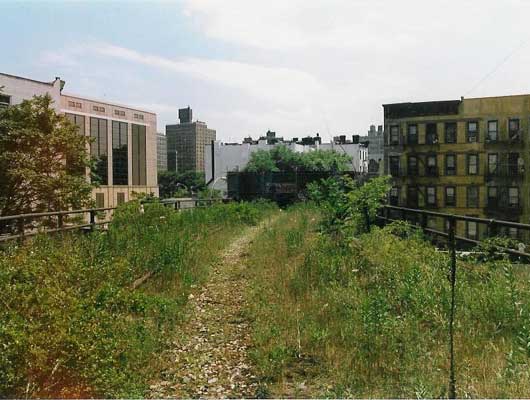
“In the beginning almost all the main groups were opposed to it,” Hammond recalled. To some people they just thought it was a relic and wasn’t attractive, and would look better torn down. To others, there was a lot of people that [said], ‘Oh it’s a great idea but it’s never going to happen.’”
(Photo: The High Line before its transformation./Courtesy of The Friends of the High Line)
Now the High Line is one of New York City’s most popular attractions, drawing more than 7 million visitors since the first section opened in 2009. That was the same year, Hammond toured Jersey City’s Embankment, and was impressed by what he saw.
Hammond thinks the “Embankment has a whole other feel to it” than the High Line.
“It feels more natural in some ways because of these stone walls. And then what’s growing up there is so much more robust and stronger than anything that was ever growing up on the High Line. In the Embankment, you really feel like you have a forest in the middle of Jersey City,” he explained.
Jersey City Councilman Steven Fulop, whose district encompasses the Embankment, is optimistic that the project will follow in the High Line’s footsteps. “We think we have an opportunity here to create something at least as powerful, if not better,” Fulop said.
If all three parties agree on the legal settlement, the city could acquire the land in as few as six months. But if the other litigants don’t agree to the terms, another court battle could set the project back five or six more years. With the neighborhood around New York’s High Line booming, city officials are more motivated than ever to see the project through to the finish.
And that excites residents in the neighborhood. Dolores Rennar has lived on 6th Street facing the Embankment for all of her 68 years, and fondly remembers the railroad where her grandfather worked.  
“I loved it,” Rennar said. “The kids used to write their names on the wall, and climb it to get coal.”
“I don’t care what they turn it into,” Rennar added, referring to the plans for the Embankment, “as long as they don’t take it down.”

Wednesday, May 9, 2012


September 12, 2011 

High Hopes for the Harsimus Embankment: 


The Fight to Create an Elevated Rail-Trail in New JerseyBy Jake Lynch
Standing next to the towering walls of century-old brownstone, looking up at the mist of sunlight pouring through wild foliage above, the vision for what the Harsimus Embankment could one day become forms easily.
© Rails-to-Trails Conservancy
The Harsimus Embankment runs six
blocks through downtown Jersey City.
The passage of time has already begun the work of transforming this unused elevated railway embankment in the heart of Jersey City, N.J., into an urban oasis. From the moment the trains stopped running in the early 1990s, Mother Nature took over. Today, the embankment supports a two-story-high, 100-foot wide, six-block wilderness of Cherry trees, wildflowers and grasses. Monarch butterflies stop for milkweed on their annual migrations south to Mexico. Attracted by the nectar, pollen and insects, mockingbirds and chickadees have moved in, their chirps and whistles replacing the industrial sounds of a bygone era.
The Harsimus Stem Embankment, or Sixth Street Embankment, as it is sometimes known, was built in the early 1900s as the residents of Jersey City demanded some relief from the constant rail traffic bringing produce and cattle to Harsimus Cove and the shores of the Hudson River. Local lore has it that every now and then a condemned cow or sheep would make a last-ditch attempt at freedom, leaping from the cars and charging wild-eyed through the streets of Jersey City.
Built from quarry-cut brown sandstone ashlar, the six block-long segments of the embankment carried seven rail lines 27 feet above street level, connected by steel bridges between each block. The bridges were removed in the mid-1990s. What remains now is not only an edifice imbued with an irreplaceable local history, but also a structure uniquely suited to becoming an urban corridor of greenspace in a time and place where such opportunities are increasingly rare. New Jersey currently ranks first in the nation among states in terms of population density and is projected to be the first fully built-out state by 2050.
In 1999, the entire site was listed in the New Jersey State Register of Historic Places and declared eligible for listing in the National Register of Historic Places. It is also an official Municipal Landmark.
So when a booming real estate economy in the late 1990s began to raise questions as to the future of the embankment, a group of local preservationists, businesspeople and families came together to ensure that development of the site was appropriate to the character of this historical neighborhood. Then, in 2005 a development company purchased the embankment site, and the owners stated their intention to demolish the structure.
© Rails-to-Trails Conservancy
Mother Nature currently reigns on the top of the embankment.
"The community initially came together in response to news that the embankment might be demolished to make way for townhomes," says Stephen Gucciardo, president of theHarsimus Embankment Preservation Coalition. "Neighbors recalled childhood memories, and the friends and relatives that worked on the railroad. A local historian described the defining role of the railroads in shaping Jersey City and the region. What evolved was an appreciation for the historical significance of the structure."
What also emerged was a remarkable vision: an elevated park along the top of the embankment, a linear escape running six blocks to the shores of the Hudson River, west to east, connected by walkways above the cross streets.
The Project
The park would not only be a spectacular place for people to relax and play, but a central pathway running through the embankment park would also provide a vital connection for pedestrians and cyclists, safely above the traffic below.
Though efforts to bring the embankment vision to fruition are currently embroiled in complex legal proceedings between supporters, the city and developers, the Harsimus Embankment Preservation Coalition continues to generate support and energy throughout the region for a New Jersey cousin to the now-famous High Line in New York City.
© Rails-to-Trails Conservancy
The Harsimus, if preserved as a linear park, would
provide a true community pathway and neighborhood
space in the heart of New Jersey.
While the embankment is considerably wider and lower to the ground than the High Line, the opportunities for smart development are the same. After visiting the embankment in 2009, Friends of the High Line co-founder Robert Hammond wrote on his blog, "I was blown away immediately... The Embankment holds an untouched beauty, and really reminded me of the feelings I had years ago in the early days of the High Line. It's another amazing opportunity for a great linear public space."
Just as the High Line would likely still be an out-of-service rail line if not for the persevering effort and lobbying of a dedicated group of citizens, a team of astute, passionate Jersey City residents has mobilized behind the embankment project, inspired by its tremendous potential for the city. According to Gucciardo, a community park and pathway is a natural fit for the structure, given the requirements of repurposing rail corridors and preserving structures. "Our city's historic preservation ordinance provided the guiding principles," he says. "It states that the structure [must] support an original or compatible use, and that there be minimal alterations. A pedestrian and bicycle greenway was the logical direction—there would be little or no impact to the landmark, and it would remain a transportation corridor."
Also, beyond the benefits of a public space for recreation and transportation, the embankment has attracted numerous supporters who envision its connection to a broader network.
The East Coast Greenway Alliance (ECGA), an influential group of planners and trails advocates, has had enormous success during the last 20 years in creating a continuous route from Maine down to Florida. They have identified the embankment as a key off-road connection from Newark east to the Hudson River waterfront. ECGA and the Jersey City Landmarks Conservancy are looking at developing a connecting trail through the historical Erie Cut and Bergen Arches, a rail cut driven deep through the rock of the Palisades in the early 1900s.
© Rails-to-Trails Conservancy
Like the High Line, a trail along the
Harsimus Embankment would create
a safe corridor above city traffic.
Jersey City elected officials and planning staff, too, have thrown their support behind the project. The current city administration has put an emphasis on addressing density concerns with urban greenspace to boost not only quality of life indices but also property values and tax receipts.
The embankment has also been talked about in city hall as a connection to a possible future light-rail station, the perfect connection to a recreational hub, a vibrant downtown area and non-motorized pathways throughout the region.
The Metropolitan Waterfront Alliance is one of a number of groups in the Tri-State area to endorse the idea of an embankment greenway.
"Together, the Embankment, the Hudson River Waterfront Walkway and the creation of the East Coast Greenway linking to New York to the cast and Kearney and Newark to the west could transform the nationwide perception of Jersey City from just another toll plaza to one of the most livable cities in the region and possibly nation," wrote Alliance co-founder Carter Craft in theNew York Times. Others stress that park space would be preferable to housing developments in helping reduce the effects of stormwater runoff on an already pollution-stressed Hudson River.
The recreational, social economic and environmental benefits of an embankment greenway seem obvious to everyone involved. Except, that is, the current owners of the site.
Back to top
In the Courtroom
© Rails-to-Trails Conservancy
Pending a case in the U.S. Court of Appeals, the
embankment could be torn down to make way for
townhomes.
Though it is always exciting to be there for the ribbon cutting, the opening day celebration or the community dedication, these happy events are often only the epilogue of a long and challenging process to bring a great trail idea to fruition. The Harsimus Embankment is a good example of how Rails-to-Trails Conservancy's (RTC) involvement in this process goes beyond fundraising, building and promotion.
At this very moment, the plan to transform the Harsimus Embankment into a recreational space and greenway for the whole community is under consideration in the United States Court of Appeals. Though the legal intricacies make for a lengthy and convoluted story, the short version goes something like this: The six-block site of the embankment, plus two at-grade parcels of the rail right-of-way, is currently owned by New Jersey developers Steve and Victoria Hyman, who bought the site from the rail company Conrail in 2005 for about $3 million. Their stated intention was to tear down the embankment and build townhouses.
That sale, however, ignored long-established federal rail abandonment legislation that affords significant opportunities to protect and preserve rail corridors for continued and future public use as a transportation corridor—an effort to mitigate the loss of the rail line as a public asset.
RTC was one of three groups, along with Jersey City and the Embankment Coalition, to challenge the legality of the sale of the embankment to developers. The suit successfully argued to the Surface Transportation Board (STB), the regulatory agency charged with resolving rail-related disputes, that the embankment was a federally regulated rail line that could not be sold to the developers without the STB's permission.
With many millions of dollars at stake, lawyers for the developer responded with a complex series of appeals and motions, including a SLAPP suit (Strategic Lawsuit Against Public Participation), filed against RTC, RTC's lawyers and the other opponents of the sale.
A SLAPP suit is a tactic often used by developers and other private interests with substantial financial and legal resources to tie up public advocates and nonprofit groups in expensive legal proceedings. In this instance, the developer, represented in court as eight Limited Liability Companies (LLCs), alleged a range of minor violations against RTC and the other opponents.
The purpose of a SLAPP suit is to force nonprofit organizations and citizens groups to back down, unable to make fundraising keep pace with growing legal bills. And it often works. But not this time.
In July 2011, the Superior Court of New Jersey dismissed the SLAPP suit and ruled in favor of RTC, the Embankment Coalition and the city.
© Roman Pohorecki
Design rendering of a bridge connector between two of the six
block-long segments of the embankment.
In his ruling, Judge Maurice J. Gallipoli wrote, "The federal rail abandonment legislation has been in place since 1976, giving ample notice to the LLCs of the potential risk associated with their purchase that could prove, and apparently has proven, quite troublesome."
Not surprisingly, the developers have appealed Judge Gallipoli's decision. However, the provisional dismissal of the SLAPP suit allowed RTC, Jersey City and the Embankment Coalition to continue their legal fight to preserve the embankment. The case is set to be heard by the U.S. Court of Appeals for the D.C. Circuit on October 18, 2011.
That the developer and Conrail have been called out on their deal, which was meant to circumvent a legislated process established to protect the public good in cases exactly like this one, is credit not only to the energy and vigilance of the Embankment Coalition and the people of Jersey City, but also to the legal expertise of RTC and the support of our members.
Since 1986, RTC's lawyers have argued the case for preserving rail corridors as public recreation and transportation assets at the local, national and federal levels in more than 50 cases, as well as before Congress and administrative agencies. RTC is the foremost, and often the only, legal advocate for rail-trails in the United States.
In 1990, RTC's pro bono attorneys were involved in the landmark Preseault v. the Interstate Commerce Commission case, in which the U.S. Supreme Court unanimously upheld the constitutionality of railbanking (the preservation of rail corridors for interim public use as a trail), paving the way for thousands of miles of rail-trails nationwide.
Since then, Andrea Ferster, RTC's general counsel since 1992, aided by a dedicated group of law firms doing invaluable pro bono work for RTC, has fought for the preservation and public acquisition of rail lines for the common enjoyment of the American people.
Without RTC's legal intervention on behalf of rail-trail projects, our national trails landscape would not look how it does today.
Matt Cohen, an RTC board member and attorney who lives in Seattle, points out that trail projects often encounter legal challenges. "It is not enough that Congress sought to preserve inactive rail corridors through the railbanking program," he says. "Local governments and friends-of-the-trail groups often face lawsuits from developers or property owners who have their own plans for a line. Underfunded local governments often turn to RTC's legal department for expert guidance when they are named in a lawsuit. Our success in defending trails frequently stems from key judicial precedents established through the hard work of Andrea and her volunteer lawyers."
© Cassandra Wilday Landscape Architects
Rendering of a street access point up to the Harsimus
Embankment.
The Paul Bunyan State Trail in Minnesota and the Armstrong Trail in Pennsylvania head a list of many trails successfully defended against lawsuits with the expert legal advocacy of Ferster and RTC's partner pro bonoattorneys. It is a service we are proud to provide, and one that is funded entirely by RTC members.
"Andrea's work might not be the most visible component of the many things we do, but it is certainly among the most critical," says RTC President Keith Laughlin. "While community groups and municipalities have demonstrated time and time again they have the enthusiasm and energy to make trails projects happen, it's our job to make sure the legal framework is in place to facilitate trail development whenever and wherever possible."
RTC also provided legal expertise to clear the way for development of the High Line. With that project hailed as an social, economic and environmental success, RTC is now working to help the people of Jersey City have a say in the future of their community.
Back to top
Rails-to-Trails Conservancy
The Duke Ellington Building
2121 Ward Ct., NW
5th Floor
Washington, DC 20037
+1-202-331-9696

Tuesday, March 6, 2012

High Line Deux


A New High Line for New York

Similar to the struggles of the original High Line in NYC, this version also aims to protect 
a structure from destruction. It's going to be so beautiful. I want to visit it now! The Queens 
(High) Line has a long ways to go before any major decisions are made. Interestingly enough, 
the idea of turning the 3.5 mile abandoned rains doesn't get as much support from the powers
that be. Is it a matter of location? In any case, we'll all benefit from another touch of green.


     The Tappan Zee Bridge will be replaced, and one proposal envisions the original as a suburban High Line.
February 22, 2012

State to Look at Turning Tappan Zee Into Walkway

It seemed quixotic at first, but maybe the idea of turning the Tappan Zee Bridge into a walkway after a new bridge is built is not so far fetched after all.
State officials said Wednesday that they were exploring the possibility of turning the three-mile-long bridge into a route for pedestrians and bicyclists along the lines of the High Line on the West Side of Manhattan, or the equally successful Walkway Over the Hudson linking Poughkeepsie and Highland.
Gov. Andrew M. Cuomo and aides said at a cabinet meeting in Albany that it would cost $150 million to demolish the existing bridge, which carries the New York State Thruway, so turning it into a walkway connecting Rockland and Westchester Counties was worth exploring.
“Could you leave it up, and what are the economics and the practicalities of that?” Mr. Cuomo said at the meeting. “It’s an exciting option.”
After more than 10 years of study, building a new bridge finally seemed to reach critical mass last fall when it was one of 14 projects chosen by the Obama administration for expedited federal review and approval — possibly allowing work on a new $5 billion bridge to begin as early as spring 2013. The bridge is 56 years old — 6 years past its anticipated life span — and needs $50 million in maintenance and repairs annually.
After the project was announced, the idea of preserving the old bridge was raised by Paul Feiner, the Greenburgh town supervisor, who proposed a walkway. The idea immediately gained support from biking and pedestrian groups. In January, the newly formed Tappan Bridge Park Alliance said that a walkway “would generate economic and community development to the region by providing a world-class destination and a much needed open space in the congested Lower Hudson Valley.”
The initial reactions from public officials were cool, and some said the steep pitch of the Tappan Zee, compared, for example, with the flat Walkway Over the Hudson, could make a park plan impractical.
But on Wednesday, Mr. Cuomo and Thomas Madison, executive director of the State Thruway Authority, endorsed further study of the project. They indicated it might make more sense to create a walkway than to tear down the existing bridge.
“I’m so excited,” Mr. Feiner said Wednesday in an e-mail. “This could become a world-class destination point.”
Despite overall applause for the coming bridge replacement, there has also been criticism that the fast progress has come at the expense of the optimal project. Transit advocates are upset that the new bridge will not include rail lines or bus service.
The Tri-State Transportation Campaign, a nonprofit group advocating for alternatives to motor-vehicle use, recently began running radio and newspaper advertisements that criticized the absence of mass transit in the current design. Hearings on the project’s environmental impact statement are scheduled for Feb. 28 in West Nyack and for March 1 in Tarrytown.
Mr. Madison and Mr. Cuomo said that the new bridge would provide areas for bikers and walkers, unlike the old one, and that it was being built to support mass transit, which can be added when more money is available.
“There has been criticism that we’ll build a bridge that doesn’t support rail,” the governor said. “That’s not true. The bridge will support the rail. The question is the rest of the system that doesn’t exist. We’re actually building a bridge that is ahead of the existing system.”

Thursday, March 1, 2012

High (Line) Hopes for New Jersey

High (Line) Hopes for New Jersey


Similar dreams, struggles and efforts to create High Line's all around the world, this one is closer to home!

High Line Hopes in Jersey City


JCHIGH


                                                                                  Roman Pohorecki
A rendering of a potential plan for the Sixth Street Embankment in Jersey City has walkways and bike paths.


After a seemingly endless legal battle, Jersey City is on the verge of getting its own version of Manhattan's High Line.
An abandoned elevated railway known as the Sixth Street Embankment has been the subject of a litigious preservation effort for more than a decade. Local groups and city officials want to transform the half-a-mile long stone structure into a grassy, landscaped park with skyline views, spanning Jersey City's gentrifying neighborhoods.
The park is also envisioned as an important link in a greenway spanning the East Coast.
Now, after a federal judge ruled against a developer blocking the park, a settlement that would hand control of the railway to Jersey City has been drafted and is awaiting approval.
"This has been an epic legal struggle," said William Matsikoudis, the Jersey City municipal attorney, who estimated the city has spent more than $500,000 in legal fees on the battle. "We're one step away from a settlement that will provide a world-class amenity for the people for Jersey City."
So far, the settlement has been tentatively approved by two of the three main litigants: Jersey City officials and Steve Hyman, a Manhattan investor who purchased the embankment from Consolidated Rail Corp. for $3 million in 2003 to knock it down and build housing. The city sued Conrail for making the sale, and Mr. Hyman, in turn, sued the city.
Under the terms of the settlement, the city would pay Mr. Hyman $7 million and Conrail would chip in $13 million to settle all the pending litigation, according to people familiar with the matter. Conrail would get development rights along the edges of the embankment, which could yield at least 300 housing units potentially valued at $10.5 million, other people familiar with the matter said.
The Jersey City Council is set to vote on the settlement Wednesday, and it appears likely to pass, said Councilman Steven Fulop, a project proponent.
The last remaining obstacle is Conrail, which is still examining the deal and wants a "number of open items" addressed, said Kevin Coakley, a partner at Connell Foley, who is representing the company. He wouldn't elaborate. "Conrail is hopeful a settlement can be achieved," he said.
Mr. Hyman, who has spent millions of dollars on the court cases, has signed the settlement, said one of his attorneys, Daniel Horgan. "Everybody wants it over with," said Mr. Horgan. "We would like everybody else to sign on it."
Even with Conrail's approval, the Jersey City version of the High Line may be a long way from reality. Initial construction could begin next year, Mr. Matsikoudis said, but designs haven't been finalized for the 110-year-old structure, formally known as the Harsimus Stem Embankment. The city would likely hold a design competition.
Still, hopes are high. It is "equal to or better than New York's High Line," said city Mayor Jerramiah Healy in a statement.
The sandstone-and-granite structure rises to 27 feet at its highest point and once carried Pennsylvania Railroad freight trains along seven tracks to the Hudson River waterfront. Conrail took over the embankment in the 1970s, but rail traffic ceased and nature took over. Ivy covers the walls and the structure is now a regular way station for monarch butterflies migrating from Canada to Mexico.
Early ideas to transform it into a park include landscaping the trees and plants already growing on top. A meandering walking trail and a bike path are possibilities along the 100-foot wide embankment, which is wider than the High Line, said Stephen Gucciardo, president of the Embankment Preservation Coalition, a volunteer group formed to save the historic relic.
Advocates want a "grand entrance" to the park's eastern section, while the western section would return to ground level and connect to the Bergen Arches, a railroad tunnel that runs through the Palisades.
The abandoned tunnel feels remote despite the highways and development around it, said Mr. Gucciardo. "It's like coming upon some kind of Mayan temple that has been overgrown. It's lost in time," he said.
The dream for advocates is to connect the embankment to the 2,600-mile East Coast Greenway, a trail that is under development from Maine to Florida. In New Jersey, 20% of the 93-mile trail is complete, said Rails to Trails, an advocacy group that promotes trails along railways.
The saga over the Sixth Street Embankment began in 1998, when former Jersey City Mayor Bret Schundler decided to knock it down for housing.
There was an outcry from residents, who in 1999 succeeded in getting the embankment added to the State Register of Historic Places. The City Council voted in 2004 to take it over for a 6.5-acre park by eminent domain.
The city sued Conrail in 2005 for selling the land to Mr. Hyman, who then filed a dozen separate suits over myriad issues involving the land.
Settlement negotiations got a shot in the arm Friday when the U.S. Court of Appeals rejected Mr. Hyman's case and backed the city.
Write to Heather Haddon at heather.haddon@wsj.com

Friday, February 3, 2012

Anandi Hearts Queens!

Gratitude and Love for Queens!


Honored and Humbled to be featured in the Queens Ledger / Brooklyn Star's "On the Record" as community & environmental activist." Thanks for the great recognition for the work that I do and for highlighting the passion I have for creating community and beautiful spaces in Queens. 


Thank you all for the love! 
~Anandi


Anandi Premlall, Community activist
by Lisa A. Fraser
Jan 27, 2012

9CQ0_QNS_OTR_1_26.jpg
If anyone is paying attention to the news in South Queens, one hot button issue is the prospect of a Queens Greenway at the abandoned LIRR tracks running along Woodhaven Boulevard, much like Manhattan's Highline Park. And one voice in the mix, which dominantly stands out among all others, is Anandi Premlall's, the South Ozone Park resident who has taken it upon herself to advocate for more green space in this part of Queens.

“We don't have a lot of Green space in Ozone Park, South Ozone Park and Jamaica, unlike a lot of other places in Queens,” she said. “I feel this would really develop the community in a really good way and preserve the history for generations.”

Premlall, who has lived in South Queens for over 20 years, has seen how the communities have become more familial in nature, and feels that the Greenway will provide a safer feeling for those living in the areas near to the abandoned track.

The issue is not a first for Premlall. She has always been involved in advocating for a better environment. The Guyanese-born Queensite has planted trees around the South Queens area, done tree stewarding in Forest Park, and is also part of Grow Richmond Hill, an active social, cultural and civic organization.

“It's all about creating beautiful space and creating community,” she said. “One of the best ways to do that is to have great spaces where people could meet and relax, hold events.”

Her main vision is to see a “sustainable community space in the area to hold multigenerational, multiethnic, safe and fun events that are also, what she calls, “edutaining” - mixing education with entertainment.

“We have such busy lives, sometimes we don't even know who our next door neighbor is but 20 years ago we knew all our neighbors; this could make us be more connected,” she said.

Premlall's love of the natural world doesn't stop there. Also a lover of poetry since she was a child, she recently published a Haiku entitled “One” in an anthology, “The Poetry of Yoga”. The poem, she says, is about connecting with nature, something she always strives for in her daily life.

In addition to voicing her opinion about a Queens Highline, Premlall is also involved in ayurvedic nutrition classes, master composting in Queens and social media consulting. Her day job involves helping people create beautiful indoor spaces.


Read more: Queens Ledger - Anandi Premlall Community activist